


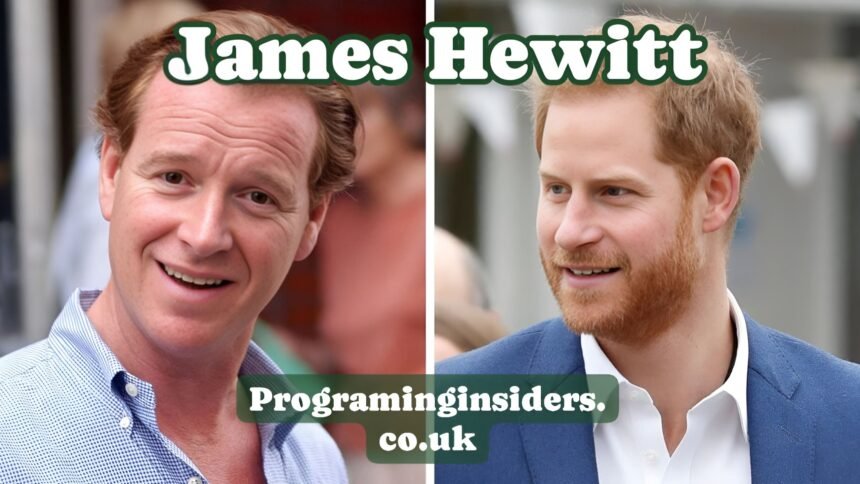
James Hewitt is a retired British cavalry officer, born on 30 April 1958 in Derry, Northern Ireland. He became internationally famous in the 1990s after it was revealed — and later confirmed by Princess Diana herself in her landmark 1995 BBC Panorama interview — that the two had conducted a five-year romantic affair between 1986 and 1991, while Diana was still married to Prince Charles.
James Hewitt is one of the most controversial figures connected to the British Royal Family. A decorated army officer who served in the Gulf War, Hewitt rose to global fame not for his military career but for his romantic relationship with Princess Diana, the most photographed woman in the world. Their affair began in 1986 when Hewitt served as Diana’s riding instructor, and it lasted nearly five years. Diana confirmed the relationship publicly in her famous 1995 Panorama interview. Since then, Hewitt has remained a fixture of royal gossip, frequently embroiled in debates about privacy, loyalty, and his proximity to the Windsor family. He has authored a memoir, survived serious health scares, and continues to attract media attention decades later. This article unpacks everything you need to know about the man, the myth, and the legacy of James Hewitt.
Quick Bio Table
| Detail | Information |
| Full Name | James Lifford Hewitt |
| Date of Birth | 30 April 1958 |
| Place of Birth | Derry, Northern Ireland |
| Nationality | British |
| Education | Millfield School; Royal Military Academy Sandhurst |
| Military Rank | Captain (retired); honorary Major |
| Years of Service | 1978 – 1994 (17 years) |
| Regiment | Life Guards, Household Cavalry |
| Gulf War Service | Yes (1991) |
| Famous For | Affair with Princess Diana (1986–1991) |
| Book | Love and War (1999 memoir) |
| Children | None known |
| Siblings | Sister Syra, twin sister Caroline |
| Notable TV | Back to Reality (winner, 2004); X Factor: Battle of the Stars (2006) |
Who Is James Hewitt? The Man Behind the Royal Scandal
Before the tabloids turned him into a global cautionary tale, James Hewitt was simply a young officer who excelled in one of the British Army’s most prestigious regiments. Born James Lifford Hewitt on 30 April 1958 in Derry, Northern Ireland, he came from a family with strong military roots. His father, John Hewitt, was a Royal Marines officer and a remarkable athlete — a pentathlete who competed in the 1952 Olympic Games. Growing up in Kent and Devon, young James absorbed a culture of discipline, sport, and service. His mother, Shirley Stamp, was the daughter of a London dental surgeon, giving the family a grounded, educated middle-class identity that shaped Hewitt’s upbringing in quiet, respectable England.
Early Education and the Road to Sandhurst
James Hewitt’s educational journey was entirely befitting a future officer. He attended Norwood Preparatory School in Exeter before moving on to Millfield, one of Britain’s most distinguished independent schools located in Street, Somerset. Millfield was known for producing elite athletes and high achievers — an environment perfectly suited to a young man with ambition and athletic ability. After completing his secondary education, Hewitt pursued the path his father had blazed before him. He earned admission to the Royal Military Academy Sandhurst, the legendary institution that has trained generations of British Army officers. It was at Sandhurst that Hewitt’s military identity truly took shape, and where his trajectory toward the Household Cavalry was first set in motion.
Commissioned Into the Life Guards
On 8 April 1978, Hewitt was commissioned as a second lieutenant into the Life Guards, one of the two regiments comprising the Household Cavalry — the sovereign’s personal bodyguard. It is one of the most prestigious postings in the British Army, associated with ceremony, honour, and impeccable standards. He was promoted to lieutenant on 8 April 1980 and later transitioned from a short service commission to a special regular commission on 1 October 1981, demonstrating his intention to build a full military career. His years in the Household Cavalry gave him access to royal circles and the refined social world of the British establishment — connections that would eventually change the course of his life and make his name synonymous with royal controversy.
How James Hewitt Met Princess Diana
The story of how a cavalry officer came to be romantically connected to the Princess of Wales begins with something as ordinary as horseback riding. Hewitt, who was still serving in the Household Cavalry, was approached to give Princess Diana riding lessons. Diana, despite being a member of the royal family, had a deep-seated fear of horses — an anxiety she wanted to overcome. Hewitt, a confident and experienced equestrian, was the ideal instructor. The two are believed to have first connected in 1986, though Hewitt himself has suggested he first encountered Diana at a polo match in 1981, before her marriage to Prince Charles. Regardless of when exactly their first meeting occurred, it was the riding lessons of 1986 that ignited a relationship that would shake the monarchy.
Also read this: Actress Janine Duvitski: Britain’s Beloved Comedy Legend and Timeless Star
A Secret Hidden in Plain Sight
Almost immediately after the riding lessons began, something more than horsemanship developed between them. British newspapers were quick to pick up the scent. The relationship was first hinted at in Nigel Dempster’s column in the Daily Mail, before the News of the World ran a full story on the romance. Despite the media speculation, neither Diana nor Hewitt publicly confirmed or denied the reports for years. The relationship endured for approximately five years, from 1986 to 1991. During this time, the two reportedly exchanged heartfelt personal letters, with Diana writing to Hewitt even while he was deployed during the 1991 Persian Gulf War — a detail that underscored just how emotionally significant the relationship had become for both parties involved.
The Gulf War and the End of the Affair
When Hewitt was posted to Germany and subsequently served in the Gulf War of 1991, the physical separation put enormous strain on the relationship. The pressures of military life, the danger of active service, and the distance between them began to erode the connection they had built over five years. Diana wrote to him during this period, and the letters she sent were later reported to be among the most private and emotionally revealing documents she ever produced. When the war ended and Hewitt returned to Britain, the romantic relationship between them had effectively run its course. It fizzled out quietly, leaving both individuals to navigate the aftermath of a secret that would not remain secret forever. Hewitt retired from the British Army on 1 March 1994, after 17 years of distinguished service.
Diana’s 1995 Panorama Confession That Shocked the World
For years, the affair between Princess Diana and James Hewitt existed in a murky space of rumour and tabloid speculation. That all changed on 20 November 1995, when Diana sat down with journalist Martin Bashir for the most watched television interview in British history. In the BBC Panorama broadcast, Diana was asked directly whether the relationship with Hewitt had gone beyond a close friendship. Her answer was unflinching. “Yes, it did,” she said, before adding: “Yes, I adored him.” With that admission, the affair became official royal history. The world watched in stunned silence as the Princess of Wales dismantled the royal facade in real time. For Hewitt, the interview confirmed his place in history — though not the kind of legacy most army officers dream of leaving behind.
The Book, the Letters, and the Betrayal Controversy
In 1994, author Anna Pasternak published Princess in Love, a book based heavily on Hewitt’s accounts of the affair. The publication was widely condemned as a betrayal of Diana’s trust, and Diana herself expressed deep distress about it in her 1995 interview. Then, in 2003, Hewitt attempted to sell 64 personal letters written to him by Diana for a reported £10 million. The backlash was immediate and severe. Sarah, Duchess of York, publicly denounced the move as an act of betrayal. Hewitt also published his own memoir, Love and War, in 1999, in which he detailed the emotional arc of the relationship from its beginning through its painful end. Critics argued that Hewitt had repeatedly monetised his connection to Diana in ways that showed little respect for her memory or their private history.
The Prince Harry Paternity Rumours — Debunked
Few topics in royal gossip have proven more persistent than the speculation that James Hewitt, and not Prince Charles, is the biological father of Prince Harry. The rumour gained traction primarily because of the physical similarities between Hewitt and Harry — both have red hair and similar facial structures. However, the timeline makes the claim impossible. Harry was born on 15 September 1984, meaning he was conceived around Christmas 1983 — nearly three years before Diana and Hewitt’s confirmed relationship began in 1986. Hewitt himself has been categorical on the matter. In a 2017 interview with Australia’s Channel Seven, he was asked directly: “Are you Prince Harry’s father?” His reply was unambiguous: “No, I’m not.” Diana’s former royal protection officer, Inspector Ken Wharfe, also confirmed in his memoir Diana: Closely Guarded Secret that “a simple comparison of dates proves it is impossible.”
Health Crisis, Cocaine Arrest, and Personal Struggles
Life after the army and after Diana was not easy for Hewitt. In July 2004, he was arrested outside a restaurant in Fulham after police found cocaine on his person. He was with CNN journalist Alison Bell at the time. The small quantity — 0.36 grams — earned him a warning rather than a criminal charge, but the incident damaged his reputation further and resulted in his firearms licences being revoked due to what police termed “intemperate habits.” Then, in May 2017, news emerged that Hewitt had suffered both a heart attack and a stroke, leaving him fighting for his life in hospital. The health scare was a sobering reminder of his mortality for the man who had once stood at the epicentre of a global royal drama. He survived, but the episode underscored the turbulence that had come to define his post-military life.
Life After Diana — Television, Business, and Reinvention
Despite the controversies, James Hewitt made several attempts to rebuild his public image and find financial stability. After retiring from the army in 1994, he opened a golf driving range — a modest but grounded venture. He won the Channel 5 reality show Back to Reality in 2004, a programme that brought together former reality TV contestants. In 2006, he appeared on the celebrity version of The X Factor: Battle of the Stars, embracing the world of light entertainment in an effort to stay relevant. He also ventured into the hospitality industry, opening a high-end cocktail bar called The Polo House on the fashionable Golden Mile in Marbella, Spain, in 2009. The bar, which offered al fresco dining and light bites, eventually closed in 2013. These ventures reflected a man trying to carve out a new identity beyond his royal notoriety.
James Hewitt in Popular Culture — The Crown and Beyond
The story of James Hewitt and Princess Diana has proven irresistible to dramatists and filmmakers. In 1996, a film titled Princess in Love, directed by David Greene and based on Anna Pasternak’s book, was released, with Christopher Villiers playing Hewitt and Julie Cox as Diana. But the most significant cultural reimagining came decades later, when Netflix’s critically acclaimed series The Crown cast actor Daniel Donskoy as Hewitt in its fourth season. Donskoy’s portrayal brought Hewitt to a new generation of viewers around the world, reigniting interest in the affair and the broader story of Diana’s marriage. Hewitt was also portrayed by Gareth Keegan in the stage musical Diana. These dramatisations have ensured that the name James Hewitt remains part of the cultural conversation around the British royal family long after the events themselves.
What James Hewitt Thinks About It All Today
In recent years, Hewitt has occasionally re-entered the public sphere to offer reflections on the affair, on Diana’s legacy, and on the ongoing dramas of the royal family. In a 2022 appearance on Good Morning Britain, he spoke out strongly against journalist Martin Bashir and the BBC, calling the methods used to secure the 1995 Panorama interview a “stitch-up job.” He expressed profound sympathy for Diana’s position and criticised the way she had been manipulated into the broadcast. He has also commented on the rift between Princes William and Harry, suggesting Diana would have been deeply troubled by it and would have worked tirelessly to reconcile them. These appearances paint a picture of a man who, whatever his past failings, retains genuine affection for the woman who once loved him.
The Legacy of James Hewitt — Scandal, Regret, and History
The story of James Hewitt is ultimately a story about proximity to power, the price of royal love, and the way institutions and individuals collide in the glare of public attention. He was a soldier who became a symbol — of Diana’s unhappiness, of the cracks within the Windsor marriage, and of the human cost of living in the shadow of a global icon. He expressed profound regret about publishing the affair, and even admitted in a 2011 interview that he had contemplated suicide after the relationship ended, saying only his mother’s intervention had saved his life. His journey from decorated cavalry officer to tabloid fixture is a cautionary tale, but also a deeply human one. Whatever history’s final verdict on James Hewitt, it is clear that his connection to Princess Diana defined him — for better and for worse — in ways he could never have anticipated.
Conclusion
James Hewitt’s life is a compelling intersection of military honour, romantic obsession, public scandal, and personal reinvention. He entered Diana’s world as a riding instructor and left it as one of the most talked-about men in Britain. His relationship with the Princess of Wales, confirmed by Diana herself, remains one of the most significant personal revelations in modern royal history. Despite controversy, health struggles, failed business ventures, and enduring media scrutiny, Hewitt has survived — and continues to offer his perspective on a chapter of British history that shows no sign of fading from public memory. Understanding who James Hewitt is requires looking beyond the tabloid caricature and recognising a complex man caught in circumstances far larger than himself.
FAQs About James Hewitt
Q1: Who is James Hewitt?
James Hewitt is a retired British cavalry officer born in 1958 in Northern Ireland, best known for his five-year romantic affair with Princess Diana, which she confirmed publicly in her 1995 BBC Panorama interview.
Q2: When did James Hewitt and Princess Diana’s affair begin?
Their affair is confirmed to have begun in 1986, when Hewitt was giving Diana riding lessons while serving in the Household Cavalry.
Q3: Did James Hewitt write a book about his relationship with Diana?
Yes. His memoir, Love and War, was published in 1999. Additionally, Anna Pasternak’s 1994 book Princess in Love was based largely on his account of the affair.
Q4: Is James Hewitt Prince Harry’s father?
No. This is a persistent rumour that has been firmly denied by Hewitt, by Diana’s royal protection officer, and by a straightforward look at the timeline. Harry was born in 1984, two years before the affair began.
Q5: What did Diana say about Hewitt in the Panorama interview?
Diana confirmed the affair, saying she had “adored” Hewitt. She also expressed distress about his involvement in the Princess in Love book, calling it very upsetting.
Q6: What is James Hewitt doing now?
As of recent reports, Hewitt lives relatively quietly. He has made occasional media appearances and has spoken out on topics related to Diana’s legacy, including criticising Martin Bashir’s methods in securing the 1995 Panorama interview.
Q7: Did James Hewitt ever marry or have children?
No. James Hewitt has never married and has no known children. He has an older sister named Syra and a twin sister named Caroline.
Fore more info: Programinginsiders.co.uk