



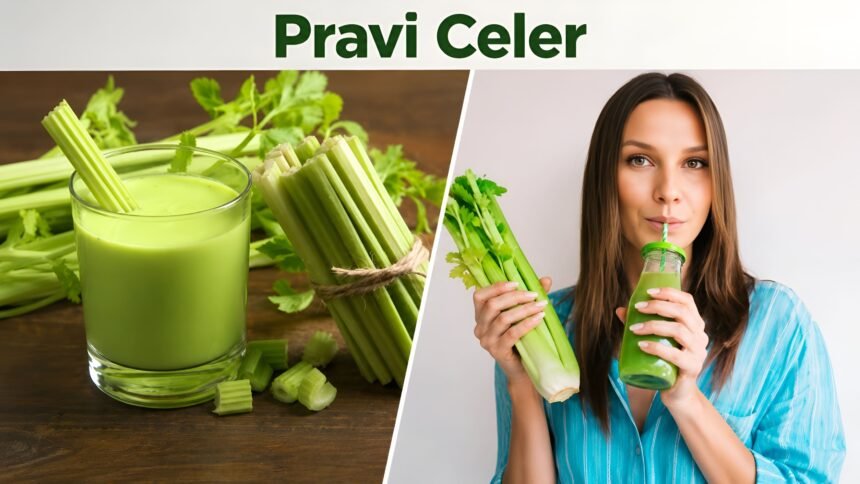
Pravi celer means “true celery” in Slavic languages and refers to the whole celery plant — stalks, leaves, roots, and seeds — used in its most natural form. It is rich in vitamins A, C, and K, potassium, and powerful antioxidants like apigenin and luteolin. It supports digestion, lowers blood pressure, reduces inflammation, and detoxifies the body with only 10–16 calories per 100 grams.
Pravi celer, also called true celery, is the complete celery plant including stalks, leaves, roots, and seeds. Rich in antioxidants, vitamins, potassium, and anti-inflammatory compounds, it supports heart health, digestion, detoxification, and brain function. Traditional Slavic medicine has used pravi celer for centuries as a natural remedy for blood pressure, gut health, and immune support. Modern research now confirms many of these health benefits.
What Is Pravi Celer?
Most people walk past celery in the grocery store without a second thought. It gets tossed into soups, paired with dips, or overlooked entirely. But in Slavic and Balkan countries, there exists a deeper relationship with this plant — one built over centuries of traditional medicine, wholesome cooking, and genuine respect for natural healing. That relationship is captured in two simple words: pravi celer.
Pravi celer translates directly from Croatian and other Slavic languages as “real celery” or “true celery.” The distinction matters more than it seems. While modern supermarkets sell trimmed, pale celery stalks that have been stripped of their leaves and roots, pravi celer embraces the entire plant — stalks, dark leafy tops, knobby celeriac root, and even the seeds. Each part carries its own concentrated nutritional value. Together, they form one of the most complete, nutrient-dense vegetables available to the everyday person without requiring expensive health supplements or exotic ingredients.
This article explores everything you need to know about pravi celer — its history, nutritional profile, proven health benefits, culinary versatility, and why modern nutrition science is finally catching up with what traditional healers understood thousands of years ago.
The Ancient History of Pravi Celer — From Pharaohs to Folk Medicine
Celery in Ancient Egypt, Greece, and Rome
The story of pravi celer stretches back more than 3,000 years. Celery seeds were discovered inside the tomb of Egyptian Pharaoh Tutankhamun, revealing just how sacred this plant was to ancient civilizations — not merely as a food, but as a symbol of healing and spiritual significance. Ancient Egyptians prescribed celery preparations to treat nervous conditions, poor digestion, and general weakness. They believed the plant carried protective energy, and its presence in royal burial chambers was deliberate and meaningful.
Traditional Use Across Centuries
The Greeks and Romans elevated celery to near-mythological status. Greek athletes were crowned with celery wreaths at the Isthmian Games as a symbol of strength and honor, while the Romans dedicated it to Neptune, their god of the sea. Hippocrates, the father of modern medicine, documented celery’s digestive and anti-inflammatory uses in ancient texts. By the 17th century, celery had crossed from the world of medicine into European kitchens, initially used only as a seasoning before eventually becoming a full culinary ingredient. In Slavic and Balkan households, pravi celer remained a kitchen staple for generations — a base for broths, a winter remedy, and a trusted natural tool for liver support, joint pain, and gut health.
Botanical Profile — What Makes Pravi Celer Different From Regular Celery
The Whole Plant Philosophy
What separates pravi celer from the celery most people know is not biology — it is philosophy. Botanically, both refer to Apium graveolens from the Apiaceae family, which also includes carrots, parsley, and fennel. The difference lies entirely in how the plant is used. Standard supermarket celery focuses exclusively on the pale, trimmed stalks. Pravi celer uses everything: the dark green stalks, the nutrient-rich leafy tops, the dense celeriac root, and the seeds that function as a powerful spice. Each component delivers a unique set of vitamins, minerals, and bioactive compounds that are lost when the plant is processed or sold in partial form.
The Three Main Varieties
There are three key varieties of this plant worth knowing. Stalk celery (Apium graveolens var. dulce) is the most familiar, with long, crunchy ribs and a mild, slightly salty flavor. Celeriac (Apium graveolens var. rapaceum) is the bulbous root form, earthy and dense, popular in Central and Eastern European cooking. Leaf celery (Apium graveolens var. secalinum) is the most intensely aromatic variety, used as a fresh herb across Asian and Mediterranean cuisines. The pravi celer tradition integrates all three, maximizing what this single plant family can offer to human health and flavor.
Nutritional Value of Pravi Celer — A Closer Look at What’s Inside
Vitamins, Minerals, and Macronutrients
At just 10 to 16 calories per 100 grams, pravi celer punches far above its weight in nutritional density. A single cup of raw chopped celery provides meaningful amounts of vitamin K, essential for blood clotting and bone integrity. Vitamin C supports immune defense and collagen production. Vitamin A maintains healthy vision and skin. The entire B-complex group — including B1, B2, B6, and folate — supports energy metabolism, nerve function, and cellular repair. On the mineral side, potassium regulates blood pressure, sodium balances fluid levels, magnesium supports muscle and heart function, and phosphorus contributes to strong bones and teeth.
Powerful Bioactive Compounds
Beyond standard vitamins and minerals, what makes this vegetable truly medicinal is its dense collection of bioactive phytochemicals. Apigenin and luteolin are flavonoids with documented anti-inflammatory and antioxidant properties that protect cells from oxidative stress linked to chronic disease. Phthalides give celery its distinctive aroma and actively contribute to blood pressure regulation by relaxing arterial walls. Polyacetylenes are phytochemicals currently under research for potential anti-cancer activity. Coumarin prevents damage from free radicals and stimulates white blood cell activity, strengthening the immune response. The leaves of the plant contain higher concentrations of vitamin C, calcium, and certain antioxidants than the stalks — a compelling reason not to discard them.
Top Health Benefits of Pravi Celer Backed by Science
Heart Health and Blood Pressure Regulation
One of the most well-documented benefits of pravi celer is its positive effect on cardiovascular health. The phthalides in celery relax the smooth muscle tissue lining blood vessels, widening them and reducing the resistance that raises blood pressure. At the same time, high potassium content counteracts the blood-pressure-raising effects of dietary sodium. Traditional Slavic healers prescribed celery juice for hypertension long before pharmaceutical blood pressure medications existed, and modern nutritional science has validated this use. Regular consumption can contribute meaningfully to reduced systolic blood pressure over time, particularly when combined with a balanced diet.
Digestion, Gut Health, and Metabolic Support
Fiber, Gut Bacteria, and Digestive Comfort
Pravi celer is a genuinely effective digestive aid, and the reasons are well understood. Its soluble fiber dissolves in water to form a gel-like substance that slows digestion, stabilizes blood sugar, and feeds beneficial gut bacteria. Its insoluble fiber adds bulk to stool, preventing constipation and supporting regular bowel movements. Organic acids in celery stimulate gastric juice production, helping the stomach break down food more efficiently and reducing post-meal bloating. In folk medicine, celery leaf tea was commonly brewed after heavy meals as a stomach settler — a tradition that modern nutrition fully supports.
H3: Blood Sugar Regulation and Weight Management
Apigenin, one of celery’s key flavonoids, has shown in studies the ability to lower blood glucose levels and improve insulin sensitivity. This makes pravi celer a smart addition to the diet for anyone managing or preventing type 2 diabetes. Beyond blood sugar, the combination of extremely low caloric density, high water content at approximately 95%, and satiating dietary fiber makes it one of the most practical weight-management foods available. You can eat a large volume of celery and feel genuinely satisfied while consuming almost no calories — a nutritional advantage that very few foods can match.
Anti-Inflammatory and Immune-Boosting Properties
Fighting Chronic Inflammation Naturally
Chronic low-grade inflammation sits at the root of many of the most serious modern diseases — heart disease, arthritis, metabolic syndrome, and certain cancers. The flavonoids apigenin and luteolin in pravi celer directly inhibit inflammatory signaling pathways in the body, reducing the production of pro-inflammatory molecules called cytokines. Clinical studies on diets rich in these compounds show measurable reductions in systemic inflammation markers in the blood. For older adults, people with autoimmune conditions, or anyone under persistent physical or psychological stress, regularly eating celery provides a consistent, natural anti-inflammatory intervention without side effects.
Antioxidants and Immune Defense
Free radicals — unstable molecules produced by pollution, stress, processed foods, and normal metabolism — damage healthy cells and accelerate aging and disease. Vitamin C, luteolin, and coumarin from pravi celer act as antioxidants that neutralize these harmful molecules before they can cause lasting damage. Coumarin specifically activates white blood cells, the frontline soldiers of the immune system, making the body faster and more effective at defending against infections. Regular consumption of antioxidant-dense whole foods is one of the most consistently supported strategies in preventive medicine.
Pravi Celer for Brain Health and Mental Wellness
Neuroprotective Effects and Cognitive Function
The connection between diet and brain health is increasingly well-supported by research, and practitioners have a notable role to play. Luteolin, present in significant amounts in celery leaves, has demonstrated neuroprotective effects in laboratory studies — it inhibits neuroinflammation, supports memory function, and improves cognitive performance. Perhaps most remarkably, a unique compound called L-3-n-butylphthalide (3nB), found almost exclusively in celery, is being actively investigated for its role in preventing Alzheimer’s disease. Preliminary research suggests it can slow the accumulation of amyloid plaques in the brain and protect neural pathways from degeneration.
Stress Reduction, Sleep, and Nervous System Support
Magnesium and the full spectrum of B vitamins in celery work together to support a calm, well-functioning nervous system. Magnesium in particular is widely recognized for its ability to reduce circulating cortisol — the body’s primary stress hormone — and promote deeper, more restorative sleep. In traditional European medicine, celery was one of the first-line recommendations for nervousness, insomnia, and mental exhaustion. While celery alone is not a cure for anxiety or sleep disorders, its consistent inclusion in the diet contributes to the kind of nutritional foundation that supports emotional resilience and mental clarity over time.
Detoxification and Kidney Health
Natural Diuretic Properties
Pravi celer functions as a mild but effective natural diuretic, meaning it encourages the kidneys to increase urine output and flush excess fluids, salts, and metabolic waste products from the body. This property is particularly valuable for people with mild hypertension, water retention, or those recovering from illness. Traditional Slavic healers routinely used celery juice to support liver and kidney function, and contemporary nutritionists continue to recognize its role in the body’s natural cleansing process. Unlike pharmaceutical diuretics, celery achieves this effect gently and without depleting essential electrolytes like potassium.
How to Choose, Store, and Use Pravi Celer in Daily Life
Selecting Fresh, High-Quality Celery
Knowing how to choose quality celery at the market is the first practical step toward getting full nutritional value. Look for stalks that are firm, upright, and snap crisply when bent — a soft or rubbery texture signals age and moisture loss. The leaves should be bright, dark green, and aromatic rather than yellowed or wilted. For celeriac root, choose smaller, denser bulbs rather than large ones, which tend to be hollow and spongy in the center. Avoid pre-cut, pre-washed, and packaged celery whenever possible, as processing removes a significant portion of the vitamins and essential oils that make the plant medicinally valuable.
Storage, Preparation, and Culinary Uses
Fresh whole celery keeps well in the refrigerator for up to two weeks when wrapped in a damp cloth or stored upright in a container of cold water. The stalks are excellent raw as snacks with hummus, nut butter, or yogurt dips, and they add satisfying crunch to fresh salads. The leaves work beautifully as a fresh herb in soups, grain bowls, and egg dishes. The root can be roasted, mashed, or grated raw with lemon juice and olive oil in the traditional Balkan celeriac salad. Celery juice, made fresh by blending or cold-pressing the whole plant, has gained significant popularity as a morning wellness drink and is best consumed without added sugar or excessive mixing to preserve its active compounds. When cooking, add celery toward the end of the process to retain maximum nutritional content.
Precautions, Side Effects, and Who Should Be Careful
When to Limit or Avoid Celery
Despite its impressive health profile, pravi celer is not suitable for everyone in all circumstances. Pregnant women should consume it in moderate culinary amounts and avoid concentrated celery seed extracts or large quantities of celery juice, as phthalides in high doses may stimulate uterine contractions. People with kidney disease should consult a physician before increasing celery intake due to its oxalate content. Those taking blood-thinning medications like warfarin need to be mindful of celery’s high vitamin K levels, which can interact with dosing. Celery allergy, while relatively rare, is a genuine condition — particularly in Central Europe — and individuals with known sensitivities should avoid it entirely. Diabetics are generally better served by cooked rather than raw celery to manage glycemic response.
Conclusion: Why Pravi Celer Belongs in Every Kitchen
Pravi celer is not a new discovery or a trendy superfood invented by the wellness industry. It is one of humanity’s oldest cultivated plants, used for thousands of years across continents for both nourishment and healing. What is new is the scientific understanding that validates what traditional cultures always knew intuitively: this whole, unprocessed vegetable delivers genuine, measurable health benefits that go far beyond its humble appearance.
Whether you are looking to support your heart, improve digestion, manage weight, protect your brain, or simply eat cleaner and more naturally, pravi celer offers a practical, affordable, and delicious solution. Unlike expensive supplements, it needs no prescription, no special preparation, and no elaborate routine. A handful of fresh stalks, a glass of cold-pressed juice, or a slow-cooked root in a warming winter soup — any of these is a step toward better health. The plant has been waiting in your grocery store all along. The only change needed is choosing to see it differently.
Frequently Asked Questions (FAQs)
Q1: What does “pravi celer” mean?
“Pravi celer” is a Slavic phrase meaning “true celery” or “real celery.” It refers to using the whole celery plant — stalks, leaves, root, and seeds — rather than just the trimmed stalks typically sold in supermarkets.
Q2: Is pravi celer the same as regular celery?
They come from the same plant, Apium graveolens, but pravi celer refers to the complete, unprocessed plant. Regular supermarket celery usually consists only of trimmed stalks, while pravi celer includes the nutritionally rich leaves, celeriac root, and seeds.
Q3: Can pravi celer help lower blood pressure?
Yes. Celery contains phthalides, which relax blood vessel walls and reduce arterial pressure. Its high potassium content also counteracts sodium’s blood-pressure-raising effects. Multiple studies support celery’s role in cardiovascular health.
Q4: How many calories does pravi celer have?
Celery contains just 10 to 16 calories per 100 grams, making it one of the lowest-calorie vegetables available. Its high water and fiber content make it filling despite its negligible caloric load.
Q5: Is it better to eat celery raw or cooked?
Raw celery preserves more vitamins, enzymes, and bioactive compounds. However, cooked celery is easier to digest and may be preferable for people with sensitive stomachs, gastritis, or diabetes. For maximum benefit, include both forms in your diet regularly.
Q6: Can I drink pravi celer juice every day?
Fresh celery juice consumed daily in moderate amounts is generally safe and beneficial for most healthy adults. It supports hydration, digestion, and detoxification. However, those with kidney issues, celery allergies, or who are pregnant should consult a doctor first.
Q7: What part of pravi celer is most nutritious?
All parts have value, but the leaves are often the most nutrient-dense, containing higher concentrations of vitamin C, calcium, and antioxidants than the stalks. The root adds extra fiber and minerals, while the seeds are used as a concentrated medicinal spice.
Fore more info: Programinginsiders.co.uk